The team could adhere to the secure coding standard as well as update dependencies and yet ship a vulnerability which did not get noticed. The reason is simple: Real attacks aren’t always based on an established checklist. An attacker could combine an inadequate authorization rule and an open API endpoint, misuse an automated process to reset passwords or find out that a account of a customer can access another tenant’s data.
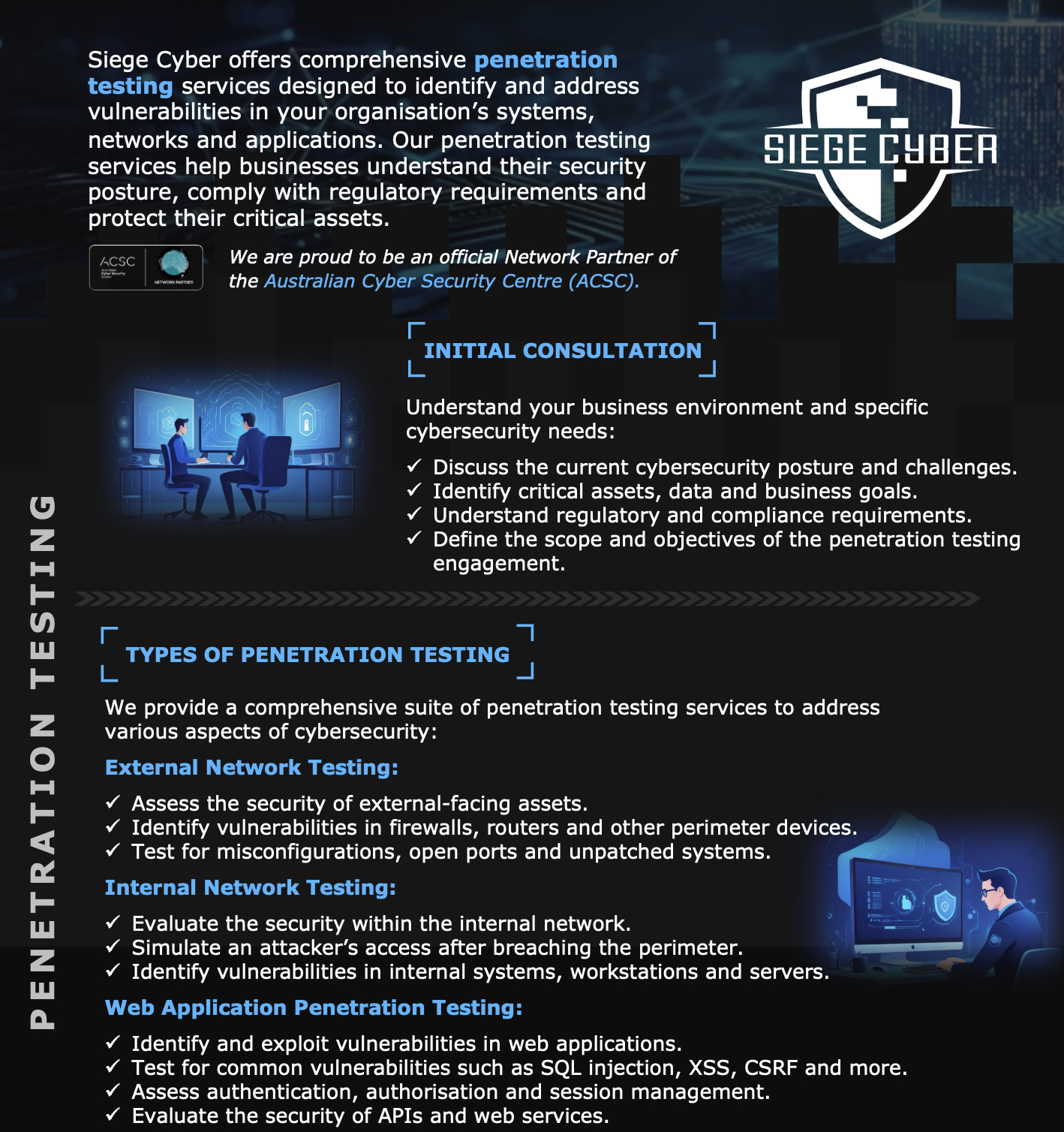
Professional penetration testing Brisbane businesses use for security assurance looks at systems from that adversarial perspective. Instead of asking if there’s security measures experienced testers will ask whether these controls can be manipulated.
The distinction is important for Australian organisations that deal with sensitive assets like health records, financial information, customer information or other assets with a high degree of security.
Automated scanning only tells part of the truth
Vulnerability scanners are very useful. They can quickly identify outdated code and headers that are not secure (CVEs), known CVEs, and clear configuration mistakes. They are not able to understand how an application should behave.
Imagine a portal for customers who wish to retrieve invoices from another company and change their account numbers. The server could return perfectly valid responses which is why an automated scanner doesn’t see anything unusual. Human testers can spot the problem with authorization in a flash.
Automated web penetration testing with manual investigation is the best way to conduct the highest quality test. The testers look for issues in session authentication, sessions, API behaviour and configuration, as well as access controls as well as injection risk API behavior.
SaaS environments pose their own security risks
Multi-tenant cloud services require be tested with care because a mistake can impact many customers at the same time.
Saas penetration tests should cover tenant isolation, API authorizations, role changes, and account recovery. Also, they must analyze integrations with other external services as well as the exposure of data, account recovery and API authorization. The tester must not only discern if a function is functioning but also if it is able to be altered to a degree the team behind the development didn’t intend to.
A user, for instance, who is assigned a simple role may not find an administrative task within the interface. This does not necessarily mean they can’t use directly. Making that distinction requires constant testing rather than simply reviewing what is displayed on the screen.
Modern web-based applications have bigger attack area
Modern applications typically combine JavaScript front ends APIs, cloud service, APIs such as identity providers, microservices, as well as third-party integrations. An issue could exist within any individual component or in the trust relationships between them.
A thorough penetration test of web apps analyzes these connections. Testers will be able to examine the process of issuance of tokens as well as whether the endpoints are able to are able to enforce authorization on a regular basis as well as how data controlled by users moves between different services, and if a low-risk flaw can be linked with a vulnerability to cause a significant security breach.
Siege Cyber is specialized in this type application testing. It utilizes modern APIs and frameworks, as well as cloud-hosted applications and complex architectures.
A helpful report could help the developers to fix the issue.
The task of identifying vulnerabilities is only half the task. If engineers can replicate an issue, identify the risk, and then confidently address it, security testing becomes extremely valuable.
Siege Cyber reports include evidence, reproduction steps, risk ratings, impact analysis, and instructions for resolving the issue. The executive summary of the risk is distributed to business partners while technicians receive the information needed to resolve it. It is possible to increase the importance of findings throughout the engagement instead of waiting for final reports.
The retesting of the system after remediation provides an additional layer of assurance to ensure that the issue was resolved without creating a brand new one.
Penetration testing can be a useful instrument for companies seeking to verify their systems, demonstrate compliance, or build certainty prior to an important release. Automated tools and policies don’t offer this, but it allows them a controlled way of determining how skilled hackers could approach the software. It is important to find the answer before the adversary.